
How Do I Know If My Dog is Overweight?
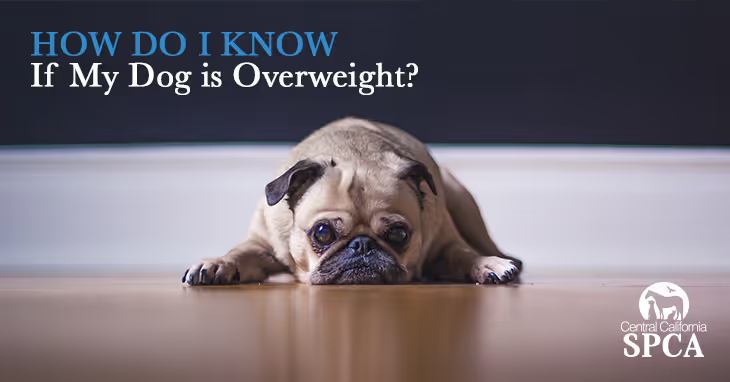
Your dog probably isn’t standing in front of the mirror wondering if her collar makes her look fat. In fact, your dog could probably care less about her spare tire, but that doesn’t mean that you should ignore it too. A recent survey by The Association for Pet Obesity and Prevention found that over 50% of America’s dogs can be classified as overweight or obese. This figure may make you wonder if your dog is overweight and wondering how to recognize the fact. That’s why we are here and making it our featured topic for the day.
Problems Caused by Excess Weight
There are a whole host of problems caused by excess weight, including those that can be life threatening. If your dog is too heavy, helping them slim down can avoid or alleviate problems, such as:
- Arthritis
- Cardiovascular disease
- Diabetes
- Respiratory problems
- Hypertension
- Kidney disease
- Shortened life expectancy
Surprisingly, 46% of owners with overweight dogs mistakenly identified their pet as being of normal weight, so it’s important for you to check signs and symptoms, just in case.
Hefty Breeds
Is your dog genetically prone to put on excess weight? Pay special attention if you own of these breeds:
- Cairn Terrier
- Dachshund
- Scottish Terrier
- Cavalier King Charles Spaniel
- Beagle
- Cocker Spaniel
- Basset Hound
- Labrador Retriever
- Golden Retriever
- Rottweiler
- Bernese Mountain Dog
- Newfoundland
- Saint Bernard
Is My Dog Overweight?
There are a few simple ways to tell if your dog is overweight:Feel for ribs - You should be able to easily distinguish the location of each of your dog's ribs under a thin layer of fat. This holds true for their spine as well.Look from above - You should be able to see their waist taper behind their rib cage before their hips.Look from the side - Again, you should see their belly taper at the waist behind their ribs.Compare averages - This should not be considered a “be all, end all” method of diagnosis as some healthy dogs’ weight can differ greatly from their breed’s average. However, researching your breed’s statistics can give you a general idea of how much your dog should way.Talk to your veterinarian - Your vet is the expert, so consult with them about whether or not they think your dog is too heavy.
What’s Causing Weight Gain?
Weight gain in a canine can be a touchy subject for most dog parents, because they are typically responsible their dog’s weight gain in one way or another.Lack of knowledge - Most of us have a hard time knowing just how much to feed our dog. Check out our recent post—Do You Know How Much You Should Feed Your Dog?—for a quick guide to determining your dog’s ideal daily intake.Poor quality food - Low-quality ingredients are usually high in calories and low in nutrition. Your dog will feel like it needs to eat more to get what it needs out of its food.Bad labeling on dog food - The daily feeding requirement labels on your dog’s food will likely represent a figure higher than what your dog actually needs. After all, the sooner you run out of food the sooner you’ll be buying a new bag.Overfeeding - Food makes our dogs happy, which makes us happy. The problem is that we can easily begin to overfeed our dogs. This is especially true with smaller breeds where a little can go a very long way.Too many treats - The same rule applies to treats. We love to reward our pups but a few extra treats each day can add up quickly. One treat can equate to us eating an extra hamburger.Lack of exercise - We’re all leading busy lives and sometimes we just don’t make time to get Rover out for a walk. An under-exercised dog will put on weight much more quickly than one who gets a daily jaunt around the neighborhood.
How to Reduce Weight and Keep It Under Control
If you find that your dog is too heavy, it’s important to help them slim down and stay in shape in order to lead a happy and healthy life.Consult with your veterinarian - Have your vet help you decide exactly how much of your particular dog food you should be serving or if another type or brand of food is necessary.Stop free feeding - If your dog free feeds, you can’t control how much they consume. Be sure to close the buffet immediately and start serving two meals a day.Portion control - Use a measuring cup to ration your dog's food at each feeding. This will ensure you don’t inadvertently over-serve.Portion reduction - Cut your dog’s food intake by 15%-20% for roughly six weeks and measure the results.Healthy treats - reward your dog with carrots or other veggies that they love rather than calorie-heavy alternatives.Diet dog food - There are several specialty brands formulated to help dogs shed excess weight. These usually contain a lot of fiber and fewer calories to keep your dog feeling full while they slim down.Quick walks - A brisk pace will help you get your dog’s metabolism going and use up more energy than a leisurely stroll. Consider the benefits for yourself as well!Stand your ground - Don’t give into those sad little puppy dog eyes. Your dog may follow you around with the “I’m so hungry” face but you’re doing this for their own good.Regular weigh-ins - Your vet will likely be happy to let you use their scale. Bring your dog in on a weekly basis to ensure they are steadily losing weight. If this seems inconvenient, use your bathroom scale as a backup. Weigh yourself and then again while holding the dog. The difference in the two is equal to your dog’s weight.Many of us love our dogs so much that we could never think of them as being “fat.” The truth is that there are more overweight dogs in American homes than normal or underweight dogs and it’s important to make sure you aren’t fooling yourself into thinking your dog is slimmer than they are. Take it upon yourself to double check and take the appropriate action if you find your dog is one of the many canines in this country that are too heavy. You’ll be doing your dog a big favor and you’ll only have yourself to thank when they live a longer, happier life.

Make a Difference, Donate to CCSPCA Today!
By donating to the CCSPCA, you are directly supporting our mission to provide programs and services that serve all stages of an animal's life. Your contribution helps us continue our work in adoptions, rescue, foster care, outreach, humane education, veterinary services, spay/neuter programs, and more.
Join Us and Help Save Animals' Lives
The modern facilities and our caring staff offer safe refuge, nourishment, medical care, and love to every animal in our Animal Center. Learn how you can get involved with CCSPCA by volunteering, donating, or fostering.
Stay Connected with Our Newsletter
Get the latest updates and news from CCSPCA
Visit us at: 103 S. Hughes Ave, Fresno CA 93706
Call us at: 559-233-7722